
O! Hole! - Eating Game
SayGames LtdCasual
4.7757.00 Reviews
- Version
- 1.1.22
- Installs
- 100.00K
- Age Rating
- Everyone 10+
Screenshots
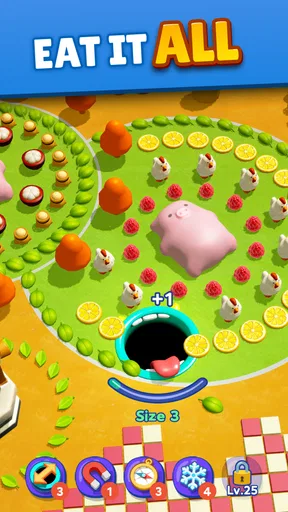
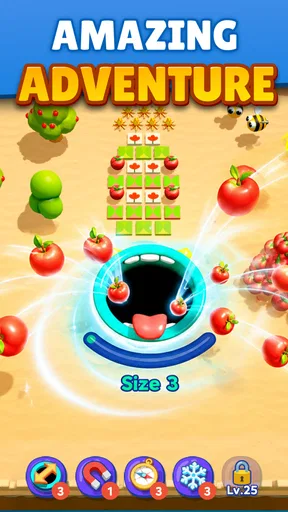
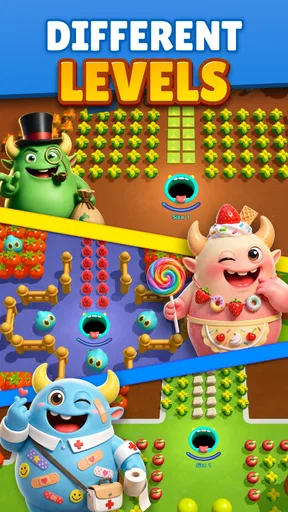
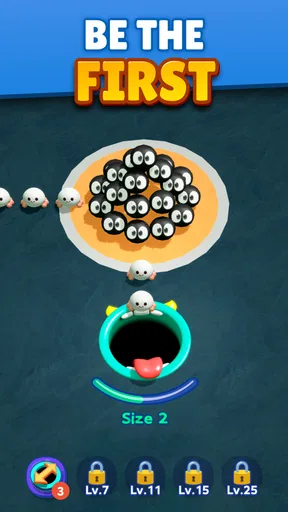
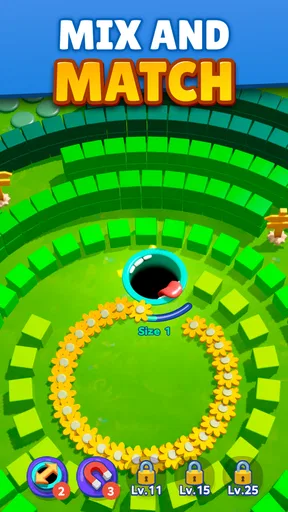
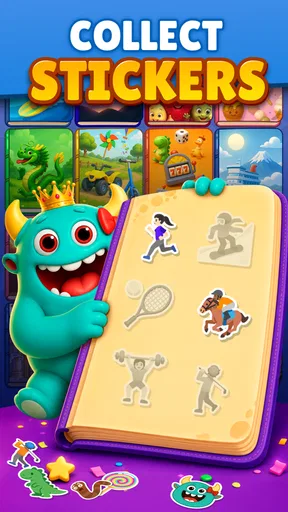
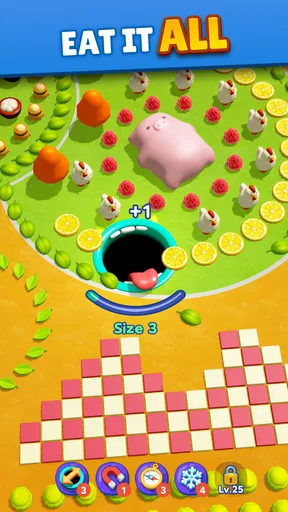
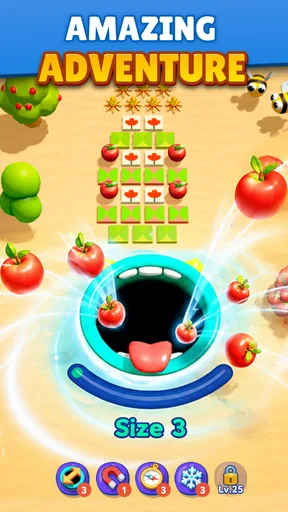
Our Review of O! Hole! - Eating Game
 Analysis by Appyee
My first few minutes with O! Hole! were immediately understandable: I moved a black hole around a compact play area, guided it beneath objects, and watched them disappear as the hole swallowed them. That simple action is the whole invitation. There is no complicated tutorial to decode, and the game gets to its point quickly. As a casual game from SayGames Ltd, it is built for short bursts rather than long, demanding adventures.
The appeal comes from seeing a small hole become more capable as it consumes more of the environment. Each successful move gives me a clear visual response, and that response encourages one more attempt. I can start while waiting for a coffee, play through a brief break, and stop without feeling that I have abandoned a large story or a complicated strategy plan. At the same time, the simplicity has limits. Players looking for deep progression, a substantial narrative, or precise competitive play may find the experience too light.
How the swallowing loop feels in practice
I’ll focus on how the swallowing loop feels once the initial novelty settles, including the small choices that make each attempt more deliberate. That practical rhythm is what helps me judge whether the game suits a quick break or starts to feel repetitive.
The first action is easy to understand
The opening interaction works because the goal is visible. I do not need to remember a long list of controls before making progress. I guide the hole toward something it can absorb, line up the movement, and receive an immediate result when the object vanishes. That direct relationship between movement and outcome makes the game approachable for people who usually avoid complicated mobile games.
What makes the first action more satisfying than it sounds is the scale relationship. At the beginning, the hole feels limited, so I pay attention to what can fit inside it. After it grows, previously awkward targets become possible. That creates a small puzzle inside the action: I am not only moving toward objects, but also considering the order in which I should collect them.
This is where the game differs from a completely mindless tapper. The controls are accessible, but positioning still matters. If I rush toward the nearest object without considering the surrounding space, I can make the next few movements less convenient. The best approach is usually to clear an easy target first, observe how the hole changes, and then use the new size to reach more valuable or larger objects.
That advice is especially useful on a phone held in one hand. Short, controlled movements are easier to correct than sweeping gestures. I found that treating the hole like a tool that needs careful placement worked better than dragging it around randomly. The game does not ask for elaborate planning, but a little restraint makes the feedback feel more deliberate.
The feedback rhythm keeps the action moving
Every successful swallow provides a compact reward: the object is removed, the space becomes clearer, and the hole feels closer to its next useful stage. This rhythm is the strongest part of the design. Action leads to disappearance, disappearance leads to growth, and growth opens another target. The sequence is easy to read even when I am playing without sound or full concentration.
I also like that the visual response does not require a separate explanation. The game communicates through motion and change. When an object vanishes, I understand what worked; when something is too large or poorly positioned, I know I need to adjust. For a casual title, that kind of immediate feedback is more important than a dense set of instructions.
There is a pleasant difference between the first few objects and the later ones in a session. Early movement is about finding an entry point. Later movement feels more like managing space and choosing a route. That gradual change gives a short round enough shape to feel like a miniature task rather than an endless screen of identical actions.
Still, the feedback loop can become repetitive if I play for too long at once. The central pleasure is visual and tactile rather than strategic in a deep sense. Once I have understood the basic pattern, the game relies on the satisfaction of repeating it with new layouts or targets. I would recommend treating it as a stop-and-start game instead of trying to turn every session into a long marathon.
Growth is the reward, but not the whole reason to continue
The most obvious reward is the hole becoming able to handle more of the environment. That change gives each swallowed object a purpose. I am not clearing space only for the sake of seeing an empty area; I am building toward the next stage of movement. This makes even small targets feel useful when they contribute to a larger sequence.
The reward also creates a practical decision. Should I take the easiest nearby object, or spend a moment positioning myself for a more efficient route? In a casual game, that choice is enough to make my actions feel personal. Two players can understand the same objective while taking slightly different paths through it.
My most useful tip is to avoid chasing the biggest visible target immediately. Clearing smaller objects can make the area easier to navigate and may put the hole in a better position for the next move. This is not a complex secret strategy, but it changes the feel of the game from frantic movement to controlled collection. When I followed that approach, I made fewer awkward corrections.
Another helpful habit is to pause briefly after a successful swallow. The next target may be easier to reach from the current position than from the direction I first started moving. Because the game gives quick feedback, it is tempting to keep dragging without reassessing. A short pause can prevent wasted movement and makes the growth mechanic more satisfying.
The reward structure is best for players who enjoy visible, immediate progress. It is less convincing for anyone who needs a large collection system, character development, or a detailed long-term objective. Here, progress is mainly tied to what I can consume during the current play sequence. That focus keeps the game clean, but it also means the experience should not be mistaken for a full-scale progression game.
Why another session begins after the reset
The reset is important to the game’s identity. Once a session has delivered its swallowing sequence and the space has been cleared, the next round offers a fresh chance to repeat the process. I do not have to protect a complicated build or remember a long chain of decisions. I can simply begin again and try to move more smoothly.
That makes the game unusually easy to return to after a distraction. If I put my phone down halfway through a casual play period, I do not feel lost when I come back. The structure supports brief attention: start, collect, grow, finish, and decide whether I want another round. This is a strong match for commuting breaks, waiting rooms, or the few minutes before going to sleep.
The reset also gives mistakes a manageable weight. A poor route or a missed opportunity does not ruin a long campaign. I can learn from the previous attempt and approach the next one with a small adjustment. For me, that was one of the better reasons to replay: not because the game demanded a major commitment, but because I could immediately test a slightly cleaner way of moving.
There is a trade-off here. Players who prefer persistent worlds may find the reset too disposable. The satisfaction is concentrated inside each round, so the game is not trying to replace a role-playing game, a management title, or a story-driven adventure. Its strength is that the restart is frictionless. Its weakness is that the reason to return may depend heavily on how much I enjoy the basic swallowing action itself.
Where it fits among casual mobile games
Compared with a traditional puzzle game, this title asks for less abstract planning. I am not studying a grid of permanent consequences or solving a complicated sequence before making a move. The puzzle element comes from positioning, timing, and choosing what to consume first. That makes it easier to pick up, though it also gives it less depth than a dedicated logic game.
Compared with an endless runner, the experience feels calmer and more deliberate. There is no need to react to a constant stream of obstacles in the same way. I can focus on the current space, make a movement, and watch the result. Someone who wants fast reflex pressure may prefer a runner, while someone who likes visible clearing and gradual growth may find this more comfortable.
It also differs from an idle game because my input matters throughout the core action. The hole does not simply grow while I watch a number increase. I have to guide it toward targets and manage its position. However, it remains lighter than an action game because the controls and objective stay narrow. That middle ground is exactly why I see it as a good occasional game rather than a main daily hobby.
The game is free to download and play, which lowers the barrier to trying it. Its in-app purchases range from $0.99 to $99.99 per item, so I would advise checking the purchase flow carefully if a child uses the device or if accidental spending is a concern. The age rating is Everyone 10+, and the playful swallowing concept is presented as casual entertainment rather than something aimed at mature players.
Practical details before installing
On the store, the game has a 4.7 average from around 9K ratings, with over 100K installs. Those figures suggest that the straightforward concept has attracted a meaningful audience, but they do not change my main advice: try it for the loop, not for the size of its audience. If the act of guiding, swallowing, growing, and restarting sounds satisfying to you, the game has a clear chance of fitting your routine.
It was released on Oct 15, 2025, and the current version is 1.1.22. The minimum requirement is Android 8.0, so the compatibility threshold is not aimed only at the newest phones. I would still think about screen comfort and control responsiveness on an older device, because small movement corrections are more enjoyable when the display reacts cleanly.
In an everyday scenario, I would use it during a ten-minute wait when I want something more active than scrolling but less demanding than a competitive match. I can complete a short sequence, stop when the moment is over, and return later without needing to reconstruct a complicated plan. That makes it a better fit for fragmented free time than for a planned evening of serious gaming.
I would skip it if I wanted multiplayer competition, a story with memorable characters, or a large strategic system. I would also skip it if repetitive action quickly loses its charm. The game’s identity is narrow by design: the pleasure comes from making the hole consume the environment and seeing the immediate payoff. No amount of extra patience will turn that central loop into a different genre.
My verdict on the complete loop
For me, the action-feedback-reward-reset cycle is coherent from beginning to end. I make a simple move, see an object disappear, gain a more capable hole, finish the available sequence, and receive a natural reason to try again. The loop does not overcomplicate itself, and that restraint is why it works as a casual game.
The best way to enjoy it is to play in short sessions and use the space intelligently. Clear manageable targets, pause to reassess after growth, and avoid treating every round like a high-stakes challenge. Those small choices bring out the game’s limited but genuine tactical layer.
My honest recommendation is simple: choose O! Hole! if you want a free, approachable swallowing game for quick breaks, and look elsewhere if you need lasting narrative or deep strategy. SayGames Ltd has focused on one tactile idea and made the path from first movement to restart easy to understand. It is not a game I would play for hours without interruption, but it is an effective little companion when I want immediate feedback, a visible reward, and a fresh session that starts without fuss.
Verdict
Strengths of O! Hole! - Eating Game
- Simple one-finger controls are easy to learn quickly.
- Short levels make it convenient for quick gaming sessions.
- Colorful visuals and playful effects create a cheerful atmosphere.
- Progression encourages players to keep completing more stages.
- Works well for casual players who prefer relaxed gameplay.
Limitations of O! Hole! - Eating Game
- Gameplay can feel repetitive after extended sessions.
- Some levels may lack challenge for experienced puzzle players.
- Ads may interrupt the experience between levels.
- Limited variety can reduce long-term replay value.
- Precision is sometimes difficult when moving the hole quickly.
Other Releases by SayGames Ltd
View All
Turbo Stars - Rival Racing
Racing4.6

Johnny Trigger: Action Shooter
Action4.6

DOP 4: Draw One Part
Puzzle4.4

DOP: Draw One Part
Puzzle4.4
Similar Picks in This Category
View All
My Talking Angela
Outfit7 Limited4.2

My Talking Tom
Outfit7 Limited4.3

Pou
Zakeh4.2

My Talking Tom 2: Pet Game
Outfit7 Limited4.3

Candy Crush Saga
King4.6

Bridge Race
Supersonic Studios LTD4.1
Frequently Asked Questions
What is O! Hole! - Eating Game?
O! Hole! - Eating Game is a casual arcade game built around controlling a growing black hole that moves across different stages and swallows objects from the environment. As you eat items, your hole becomes larger and can consume bigger targets. The gameplay is simple to understand, but completing each level efficiently requires movement, timing, and choosing the right objects before the countdown ends.
How do you play O! Hole! - Eating Game?
The main objective is to guide the hole around the level and absorb as many available objects as possible. Smaller items are usually eaten first because they help increase the hole’s size, allowing access to larger objects later. Controls are designed for touchscreens, so players can move by dragging or using on-screen input. Each stage generally rewards quick decisions and thorough exploration.
Is O! Hole! - Eating Game free to download and play?
O! Hole! - Eating Game can generally be downloaded and played without an upfront purchase, although the exact availability of advertisements, optional purchases, and other monetization features may depend on the version installed and the platform. Players should check the store listing before downloading, especially if they want to know whether extra items, rewards, or ad-removal options are offered.
Does O! Hole! - Eating Game require an internet connection?
The basic eating and level-based gameplay may work without a continuous internet connection, which makes the game suitable for short sessions while traveling or when mobile data is unavailable. However, features such as advertisements, rewards, updates, synchronization, or in-app purchases may require connectivity. Because requirements can change between releases, it is best to verify the current store information.
Is O! Hole! - Eating Game suitable for children?
O! Hole! - Eating Game uses straightforward mechanics, colorful visuals, and non-complicated objectives, making it approachable for many younger players as well as casual adult gamers. Parents should still review the age rating, advertising policy, and possible in-app purchases before allowing children to play. It is also worth checking whether the game includes external links or online features in the installed version.
Play our best games!


